
If you’re a parent of a teenager, you know the feeling. You open the door to their bedroom—or perhaps you just stand outside grimacing. You knock and opening the door upon consent, you’re met with a landscape that could rival a natural disaster zone. Clothes, books, half-eaten snacks, and what might be a small, self-sustaining ecosystem merged into a single, terrifying entity.
You might even joke (or maybe not joke) that you need a hazmat suit just to cross the threshold. Your blood pressure spikes, and the single, desperate thought that screams in your mind is: “How do I motivate my teenager!... just to clean up!”
Estimated reading time: 4 minutes

We’re going to call this the "Biohazard Zone" playfully, but I promise to treat the topic with the respect and compassion it deserves.
You’re not alone. The battle over the messy room is a universal rite of passage for parents. It feels like a personal affront, a sign of disrespect, or a terrifying preview of their future as an adult. But what if we told you that this mess is not a character flaw, but a complex, multi-layered sign of a brain that is still very much "under construction"?
What if the key to a cleaner room—and a more motivated teen—isn't nagging, but understanding?
Let’s shift the focus from the clutter on the floor to the motivation in their mind. We’ll explore the surprising science behind the "Biohazard Zone," and give you five compassionate, practical, and effective strategies on how to motivate a teenager to take ownership of their space and their life—without losing your sense of humor.
The Messy Truth: Your Teen's Room Is a Disaster Zone (and Why It's "Normal")
Before you launch into another lecture about hygiene and responsibility, take a deep breath and let’s look at the science.
The messy room is not just a behavioral issue; it is, in many ways, developmentally appropriate. Understanding this fact can instantly lower your frustration—and your blood pressure—and change your approach from conflict to coaching.
Think of the "Biohazard Zone" not as a sign of parenting failure, but as a temporary, messy stage of development.
The Science of the Mess: Prefrontal Cortex and Executive Function
The primary culprit behind the chaos is a part of the brain called the Prefrontal Cortex (PFC). This is the brain’s CEO, responsible for all the high-level skills we group under Executive Functioning (EF): planning, prioritizing, time management, organization, and emotional regulation. Here’s the kicker: the PFC is the last part of the brain to fully mature, often not finishing its work until a person is well into their twenties.
This slower development means that the neurological infrastructure required for a teen to maintain a tidy room consistently, plan a week of assignments, or even remember where they put their clean socks is literally still "under construction." Their struggle with organization is often a skill deficit, not a character flaw.
When you see a pile of clothes, you may see laziness; your teen’s brain sees a task that requires complex planning and sustained effort—a task it is not yet fully equipped to handle.
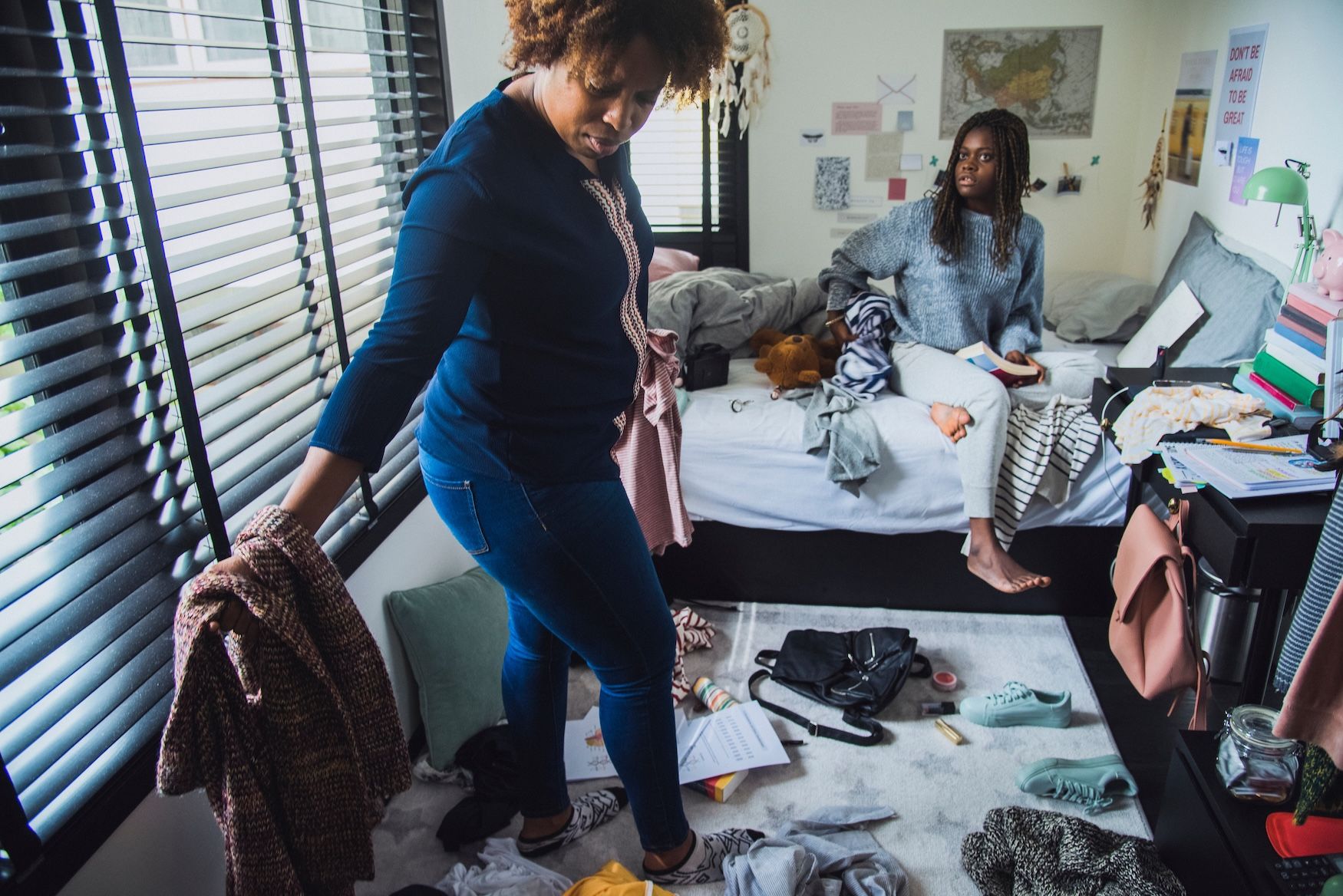
The Mess as Your Teenager's Declaration of Independence
Beyond the biology, the messy room serves a powerful psychological purpose: it’s a symbol of adolescence. As teens embark on the crucial task of forming their own identity, their room becomes their sovereign territory. The mess is a nonverbal declaration of independence and individuality.
In the struggle over control—"It's my room!" versus "It's our home!"—the mess acts as a boundary marker. It’s a way for them to say, "I get to decide what my space looks like."
While this mess and teen rebellion can feel like disrespect, it is actually a healthy, albeit frustrating, sign that your teen is actively separating their identity from yours. That’s good news!
They are testing the limits of their personal freedom, and their bedroom is the safest place to do it. YOU are the safe zone! Interpret their behavior that way instead!
Shifting the Focus: From Mess to Motivation
The real goal isn't a spotless room; it's a motivated teen, right?
The messy room—or "Biohazard Zone"—is just a symptom.
If you can help them find their internal drive, the organization will follow. The key to motivating a teenager lies in understanding the difference between extrinsic and intrinsic motivation.
- Extrinsic Motivation is external: rewards, punishments, nagging, or threats (e.g., "Clean your room or we take your phone!"). This kind of motivation works in the short term, but teaches them to act only when someone else is motivating and watching.
- Intrinsic Motivation is internal: a sense of purpose, enjoyment, or personal satisfaction (e.g., "I like having a clean desk because it helps me focus on my schoolwork and creative projects"). This internal kind of motivation is the long-term goal.
To foster intrinsic motivation, you must shift your focus from the result (the clean room) to the relationship and the skill-building process.
Recommended reading: "Intrinsic versus Extrinsic Motivation."
5 Powerful Parenting Strategies on How to Motivate a Teenager
Here are five practical, compassionate strategies to help you navigate the messy room and, more importantly, cultivate motivation in your teen.
 Connect Before You Correct: Put Your Relationship First
Before you address the mess, address the human. A teen who feels seen and understood is far more likely to cooperate. Instead of leading with a complaint, lead with curiosity.
Instead of having tunnel vision and only seeing the mess, prioritize the relationship and your connection with your teen as the highest value! For a teen, sometimes behavior is a cry for connection.

Common responses:
"Your room is disgusting! Clean it now!"
"This is like living in a pigsty! Clean it up or you're grounded."
"I can't believe you're so lazy! Look at this mess."
These judgmental comments hurt and your demands will instantly jumpstart their autonomy. Most likely, your reactions will fire up a heated and unpleasant power struggle, adding fuel to any tension already in the relationship.

Try this instead:
"Hey, I noticed you’ve been really focused on your coding project lately. I know it can be hard to switch gears. Can we talk about a quick 15-minute reset for your room?"
"I get how much you love gaming. Would you be willing to pick up your bedroom sometime before dinner?"
"You work really hard at school and sports so the last thing you probably want to do on your downtime is clean your room. Please find a time that works for you."
This approach respects their current focus and frames the clean-up as a means to an end that they value, not just a task you demand.
Related reading: "37 Inspiring Ways for Raising an Emotionally Intelligent Child."
 The Power of "Why": Helping Your Teen Find Their Purpose
Motivation is often fueled by purpose. If your teen doesn't see the point of a task, they won't do it. Instead of imposing your values (cleanliness is next to godliness), help them connect the organization to their goals.
- Ask the right questions: "What is one thing you can't do right now because of the mess?" (e.g., "I can't have friends over," or "I can't find my favorite shirt.")
- Frame it as efficiency: "If you spend 10 minutes organizing your desk, how much time will you save this week looking for your charger?"
When they realize the mess is an obstacle to their own desires, they gain the intrinsic motivation to overcome it.
In my parent coaching, I hear many challenges from parents of teenagers. One time, I recommended to a mom that she let her son have a sleepover party with five of his friends, even though his room would have for sure been classified as a biohazard zone.
To her surprise, her son’s friends refused to stay overnight without a major clean-up. They even mopped and cleaned the windows! After that night, her son kept his room reasonably clean.
 Teach, Don't Tell: Become the Executive Function Coach
Since the problem is often a skill deficiency, you need to teach the skill explicitly. Don't just say "clean your room"; break the task down into manageable, bite-sized steps.
|
Instead of saying... |
Try coaching with... |
Skill being taught: |
|
"Clean your room!" |
“Just start with the dirty laundry. Take 10 minutes and fill this basket.” |
Task initiation, time management |
|
"Put your stuff away." |
“Where’s the home for your school books? How 'bout a designated spot for them?” |
Problem-solving, organization, planning |
|
"You're so lazy." |
“I know this can be challenging because your brain is still learning how to prioritize. Would a checklist help?” |
Self-regulation, self-compassion, empathy |
This parenting approach acknowledges the challenges posed by brain development and provides the scaffolding their developing brain needs to succeed. Each time you assist in this way, your teen’s brain thanks you! You are a help in programming and coding!
Recommended reading: "Why We Think Teenage Rebellion Is Normal."
 The "Good Enough" Rule: Lower the Bar
Perfection is the enemy of progress, especially for the unmotivated teen. If your standard is "spotless," you're setting them up for failure and setting yourself up for disappointment.
Embrace the "Good Enough" rule. Outside their bedroom, you can model “spotless,” but don’t make their room the battleground.
- Define the nonnegotiables: Focus on health and safety. The floor must be clear enough to walk on, and no food or dishes can be left to attract pests. Trust me, mice relish teen messiness!
- Celebrate the small wins: Did they put all the dishes in the sink? That's a win! Acknowledge it immediately and sincerely. Positive reinforcement builds the confidence needed for bigger tasks.
 The "Out of Sight, Out of Mind" Boundary
The classic teen defense is, "Just close the door and don't look!" While it is technically “their” room, you are still the parent and the homeowner. A healthy compromise is to respect their privacy while maintaining the home's health and safety.
- The CalmPromise (not compromise): Agree to a "closed door” policy, but with the nonnegotiable limits (no food, no dishes, clear pathways).
- The Consequence: If the nonnegotiables are broken, the door remains open until the room is returned to the agreed-upon standard.
Closing Thoughts
Parenting a teenager is a masterclass in patience, humor, and letting go.
The "Biohazard Zone" is a powerful metaphor for the beautiful, chaotic, and necessary work of growing up. By understanding the developmental reasons behind the mess—the maturing brain, the quest for independence—you can stop fighting the clutter and start coaching the motivation.
Focus on connection, teach and reinforce the missing executive function skills, and trust that the capable, organized adult you hope for is slowly, messily, but surely emerging from the debris.
You got this! No hazmat suit is required (unless you find a truly ancient plate of leftovers).
Heartmanity specializes in parenting and family support. If you'd like customized parenting advice, reach out and contact us! We're here to help!